


Identity Management Data Model
The IdM data model at RWTH Aachen University consolidates a large amount of individual pieces of information into data objects, forming a type of "data packet". This facilitates the efficient exchange of personal data required for authentication and authorization between IT systems.
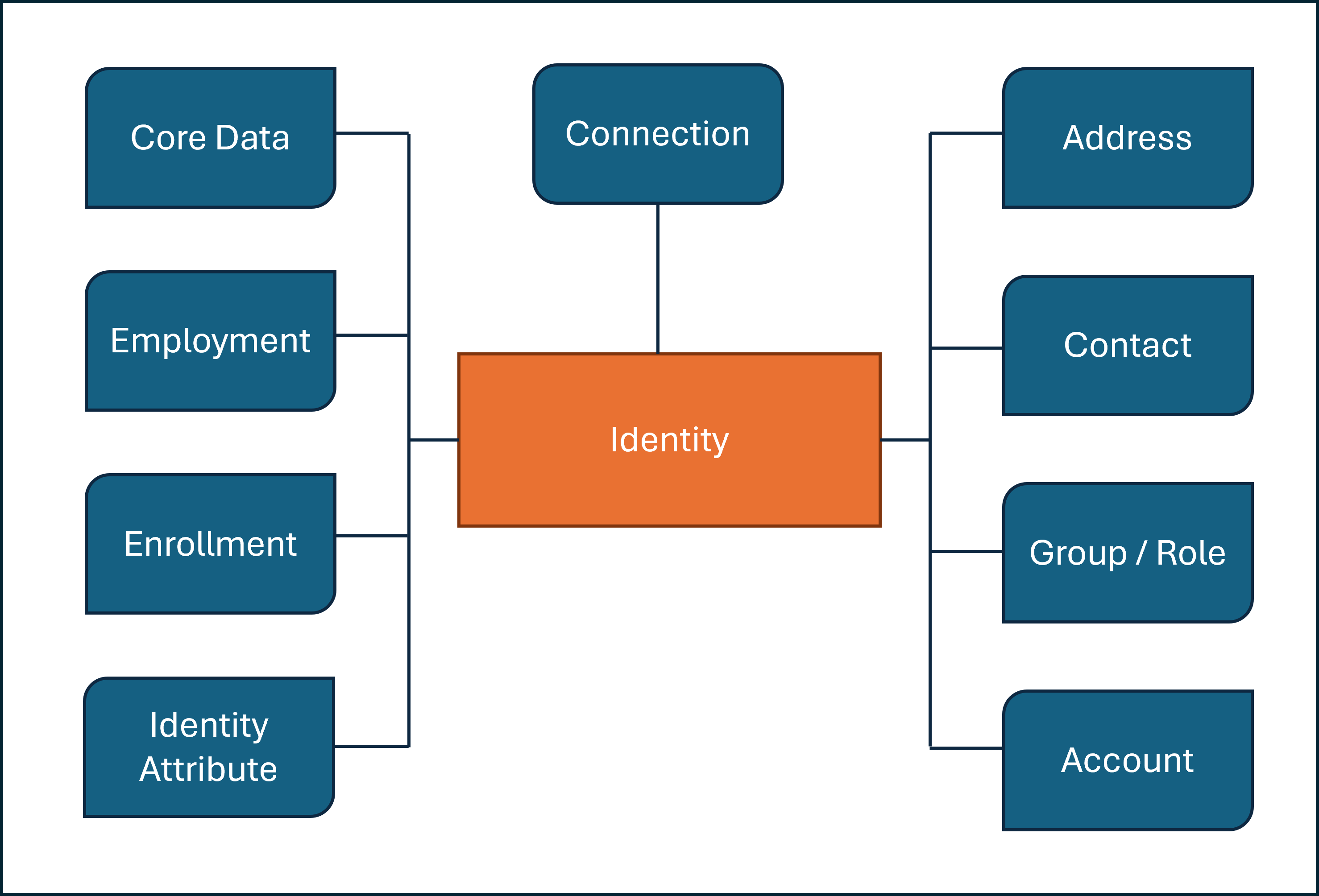
At the heart of the model is the identity — the virtual representation of a person in the Identity Management system. Each identity has a username in the form "ab123456." All other data objects associated with a person are linked to this identity.
Another key element in the data model is "connections." These represent links between the digital identity in the IdM and the systems from which personal data is imported into the IdM. They are typically created using the ConnectMe Coupon Procedure.
"CoreData" contains basic personal data such as name and date or place of birth.
Other important objects include "Enrollment," which contains enrollment data (degree program, student ID number, etc.), and "Employment," which contains employee data such as employee ID number and length of employment.
In addition, each identity contains, as needed, other specific attributes that cannot be directly mapped to the other data objects and that provide, among other things, additional information about the identity's permissions.
Identity also includes data objects such as addresses (e.g., home address and work address) or "Contact" — "Contact" contains information about the type of contact, such as whether it is an IdM contact email address or a work phone number. The corresponding value — that is, the phone number itself — is also stored.
In addition to the accounts associated with each identity (such as the email account), roles and group memberships are also stored in corresponding assignment objects (see also What is role management?).
