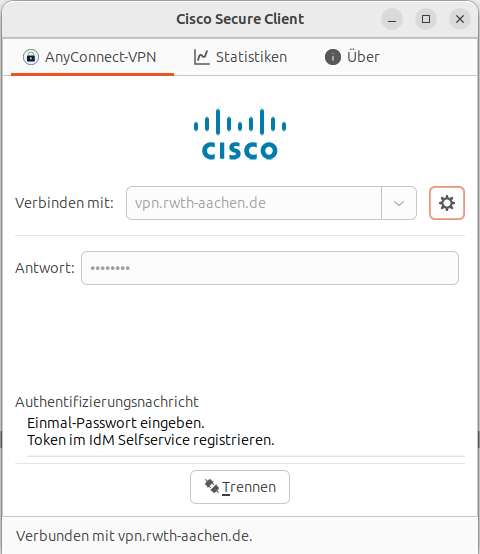


Cisco Secure Client (AnyConnect) for Linux (Ubuntu)

On this page, you'll learn how to connect to the RWTH VPN using the Cisco Secure Client on an Ubuntu device.

Important
Requirements
To establish a VPN connection to the RWTH VPN using the Cisco Secure Client on a Linux system, the following requirements must be met:
- Supported operating system installed:
- Red Hat 10.x, 9.x, 8.x
- Ubuntu 26.04, 24.04, 22.04
- SUSE-supported versions of SLES 15
- Linux versions (for ARM64)
- A fully configured VPN account in SelfService (opens in new tab)
- file for the Cisco Secure Client (AnyConnect) (opens in new tab) for Linux.
- The following files are compatible with Ubuntu:
- Intel/AMD processors: cisco-secure-client-vpn_5.x.x.x_amd64.deb
- ARM64 processors: cisco-secure-client-vpn_5.x.x.x_arm64.deb
- The following files are compatible with Red Hat and SUSE:
- Intel/AMD processors: cisco-secure-client-vpn-5..x.x.x.x86_64.rpm
- ARM64 processors: cisco-secure-client-vpn-5.x.x.x.aarch64.rpm
- The following files are compatible with Ubuntu:
You can then connect to the central RWTH VPN using the following connection details:
- Server: vpn.rwth-aachen.de
- Tunnel: Full tunnel (all traffic via the RWTH network) or split tunnel (only internal RWTH addresses are accessed via the VPN)
- VPN username: Format ab123456
- VPN password
Below you will find a step-by-step guide:
Install Cisco Secure Client
To install Cisco Secure Client, proceed as follows:
Step 1
Download the Cisco Secure Client (opens in new tab) for your appropriate Linux distribution.
Step 2
Open the terminal and run the sudo apt install filename command.
Step 3
The client will be installed.
Connect to the RWTH VPN
Connection data for central RWTH VPN:
- Server: vpn.rwth-aachen.de
- Tunnel: Full tunnel (all traffic via RWTH network) or split tunnel (only RWTH internal addresses are accessed via VPN)
- VPN username: Form ab123456
- VPN Password (set in the IdM Selfservice (opens in new tab) if required)
To connect to the RWTH VPN, proceed as follows:
Step 1
Start the client via search under vpnui.
Step 2
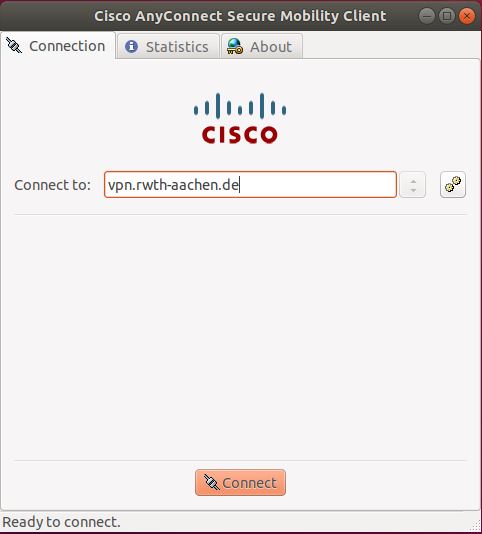
Start Cisco Secure Client and enter the address vpn.rwth-aachen.de or a valid address for an organizational VPN, then click Connect.
Step 3
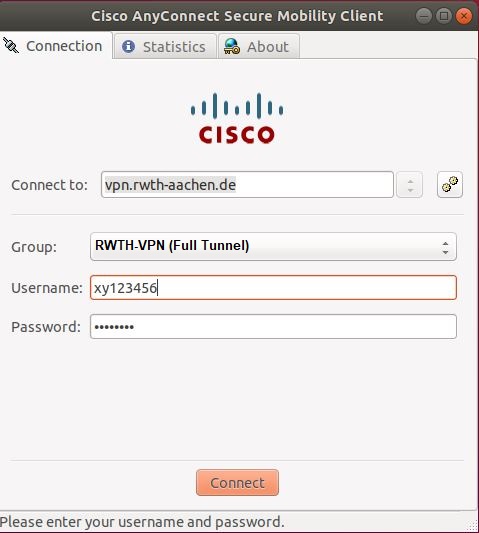
Select a connection type, RWTH VPN (full tunnel*) or RWTH VPN (split tunnel*), and then enter your username in the format ab123456 and your VPN password.
- *Full tunnel: All data traffic runs via the RWTH network.
- *Split Tunnel: Only data traffic directed to RWTH systems runs via the RWTH network. Local home network devices remain accessible.
Click on Connect to proceed.
Step 4
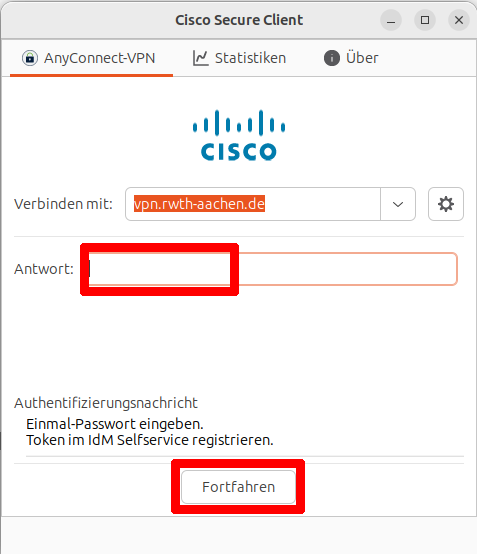
Enter the code for multi-factor authentication. You can generate a code using a token, such as an authenticator app.
Then select Continue.
You are now connected to VPN.
Step 5
You can end the connection by clicking Disconnect.