
You are located in service: SharePoint Shared Services

Introduction

Introduction

information

Over the course of this documentation SharePoint-specific terminology is used. Before working your way through this documentation you may want to make yourself familiar with the following terms.
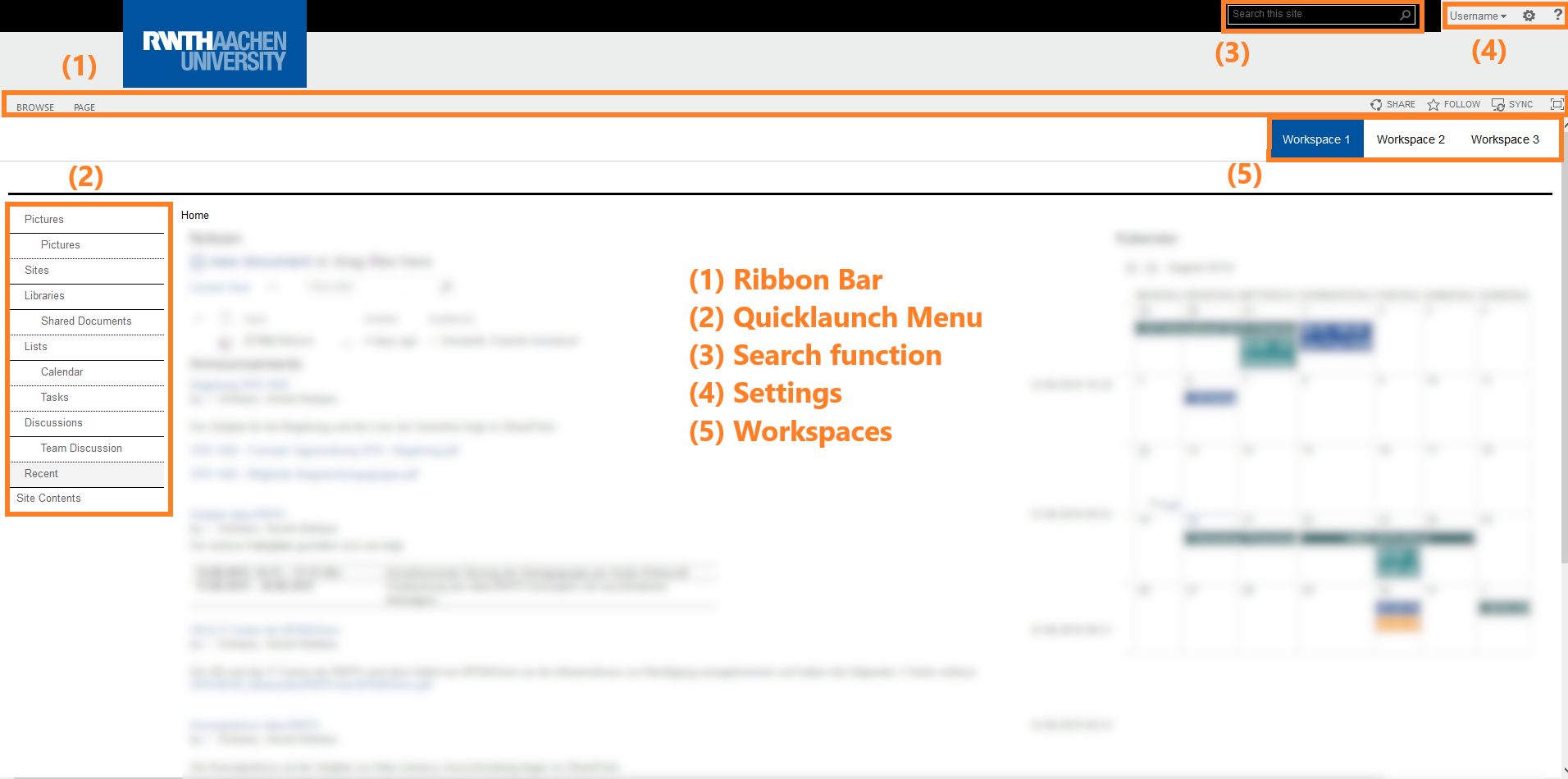
Screenshot of the SharePoint interface. Top right shows (3) Search function and (4) Settings. Below are the (1) Ribbon and then the (5) Workspaces. On the side, listed vertically, are menu items of the (2) Quick Launch bar.*

Via the tab Browse in the ribbon bar, a selection of workspaces can be selected as shown as label (5) in the picture above. When selecting a different tab, a ribbon including a multitude of tools and settings opens. If such a tab has been selected, the bar workspaces will disappear and only be accessible again after clicking on the Browse tab. The selection of available tabs varies depending on the current active SharePoint-Element. That is why the tab List, for example, is only available when currently working with a list. The following pictures illustrate the available ribbon bars of SharePoint-Elements.

Page

Screenshot of the SharePoint ribbon with the "PAGE" tab selected. The ribbon displays, from left to right, the groups "Edit", "Manage", "Share & Track", "Approval", "Workflow", "Page Actions", and "Tags and Notes" with corresponding icons.

Files

Screenshot of the SharePoint ribbon with the "FILES" tab selected. The ribbon displays, from left to right, the groups "New", "Open & Check Out", "Manage", "Share & Track", "Copies", "Workflows", and "Tags and Notes" with corresponding icons.

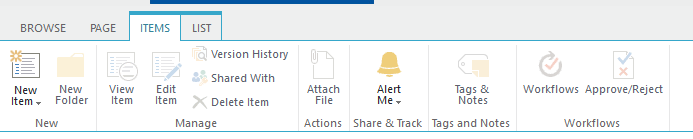
Items

Screenshot of the SharePoint ribbon with the "ITEMS" tab selected. The ribbon displays, from left to right, the groups "New", "Manage", "Actions", "Share & Track", "Tags and Notes", and "Workflows" with corresponding icons.

Library

Screenshot of the SharePoint ribbon with the "LIBRARY" tab selected. The ribbon displays, from left to right, the groups "View Format", "Manage Views", "Tags and Notes", "Share & Track", "Connect & Export", "Customize Library", and "Settings" with corresponding icons.

List

Screenshot of the SharePoint ribbon with the "LIST" tab selected. The ribbon displays, from left to right, the groups "View Format", "Manage Views", "Tags and Notes", "Share & Track", "Connect & Export", "Customize List", and "Settings" with corresponding icons.

Calendar

Screenshot of the SharePoint ribbon with the "CALENDAR" tab selected. The ribbon displays, from left to right, the groups "Scope", "Expand", "Manage Views", "Tags and Notes", "Share & Track", "Connect & Export", "Customize List", and "Settings" with corresponding icons.

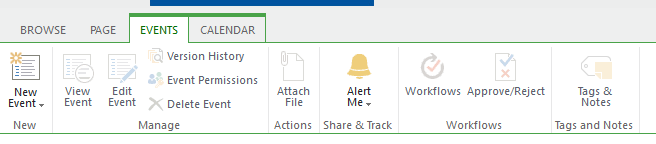
Events

Screenshot of the SharePoint ribbon with the "EVENTS" tab selected. The ribbon displays, from left to right, the groups "New", "Manage", "Actions", "Share & Track", "Workflows", and "Tags and Notes" with corresponding icons.


Hierarchy

The SharePoint-System is based upon a hierarchic folder structure. SharePoint-Workspaces are locally delimited, independent sections. Activities in a workspace A are not simultaneously executed in workspaces B, C, etc. This means for example, that when using the search function, the selection of the correct workspace is of importance. A search is always limited to the current active workspace - other unrelated workspaces are not taken into account.

The current active workspace is displayed in the workspaces ribbon.

last changed on 12/01/2025

How did this content help you?

Creative Commons Lizenzvertrag
This work is licensed under a Creative Commons Attribution - Share Alike 3.0 Germany License